
By Ryan Shakiba

Poverty remains a persistent problem in the United States, with more than 40 million people living below the poverty line. The minimum wage is one of the most debated tools for addressing this issue. Since its introduction in 1938, supporters have argued that raising the wage floor improves living standards for low-income workers, while critics warn that higher labor costs may reduce employment or hours and blunt the policy ’s intended benefits. As wage stagnation and rising living costs have led states and cities to raise their own minimum wages, this debate has only intensified.
Advocates claim that higher minimum wages directly reduce poverty by increasing earnings at the bottom of the income distribution. Critics counter that the minimum wage is a blunt instrument, raising pay for many workers who are not poor while doing little for households with unstable or informal income, and potentially reducing employment opportunities for the most vulnerable.
Because both sides make strong claims about poverty, but existing evidence is mixed, this article examines the relationship between minimum-wage changes and poverty outcomes using a state–year panel from 1980 to 2024. The dataset combines minimum-wage data from the Federal Reserve with state-level poverty rates from the CPS ASEC, assigning each state the effective minimum wage in a given year (the highest of federal or state levels).
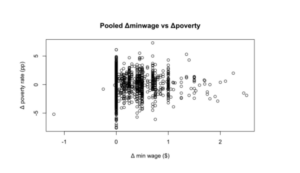
I first looked at whether changes in minimum wage levels are related to changes in poverty from one year to the next. There is a statistically detectable relationship, but it is extremely weak. States that raise their minimum wage tend to see slightly higher (not lower) poverty changes in the same year, but the effect is so small that it is essentially meaningless in real terms. In other words, even though the relationship shows up in the data, minimum-wage changes explain almost none of the year-to-year movement in poverty.
I then used a more rigorous model that compares each state to itself over time while accounting for national trends. This analysis shows no reliable link at all: years in which states raise the minimum wage do not experience larger reductions in poverty than other years. Any differences are small and statistically indistinguishable from random noise.
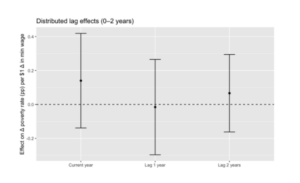
I also tested whether minimum-wage increases affect poverty with a delay, rather than immediately. To do this, I looked at changes in poverty over the following two years after a wage increase and added them together to measure the total effect. The result is still very small and not statistically reliable: over three years, a $1 increase in the minimum wage is associated with about a 0.2 percentage point increase in poverty, but this estimate is indistinguishable from zero.
In short, even when giving the policy time to work, there is no clear evidence that minimum-wage.
As a check, I tested whether poverty starts changing before a minimum-wage increase happens. If that were the case, it would suggest the results were driven by pre-existing trends rather than the policy itself. I find no evidence of this: future minimum-wage increases are not related to current poverty changes, which supports the credibility of the main analysis.
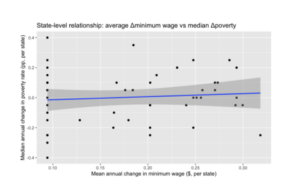
I also examined longer-run relationships by comparing minimum-wage levels and poverty rates within states over time, while accounting for national trends. This analysis shows no meaningful association either. States with higher minimum wages do not systematically have lower poverty rates once long-standing state differences and overall economic conditions are taken into account.
Using a state–year panel from 1980 to 2024, I find no clear evidence that raising the minimum wage leads to reduction in poverty. Across simple correlations, fixed-effects models, delayed-effect tests, and long-run comparisons, the relationship between minimum-wage changes and poverty is consistently weak, statistically insignificant, and often indistinguishable from zero. Even when minimum-wage increases are given time to work, poverty rates do not systematically decline in the years that follow. Additional checks show no evidence that these results are driven by pre-existing trends, reinforcing the central finding. Taken together, the results suggest that while minimum-wage policy may affect earnings for some workers, it has not translated into measurable reductions in poverty at the state level over the past four decades.
 | Article by Ryan Shakiba ’26 Data Journalist |  |
