

By Caleb Rasor
One of the most significant outcomes of divorce is the division of child custody, and in the United States, each state’s law treats this decision differently. Data can help us understand the real-world impacts of custody statutes, thereby assisting legislators in designing policy that promotes marriage stability while mitigating abusive situations. In contrast to past research and reporting, I find that state-level joint custody presumption laws result in no significant change in either divorce rates or spousal domestic violence rates relative to states without such laws.
Inspiration & Hypotheses
A widely circulated Wall Street Journal article from September 2025 examined an alteration to Kentucky’s custody law in 2018, which now codifies joint custody as the default. The law was championed by so-called fathers’ rights activists, many of whom had previously felt that the legal system was stacked against them and credited the law with giving them equal access to their children. Proponents of the law argue that it encourages more stable families by helping married couples dealing with disagreements “realize they’ll be in regular touch regardless, so ‘they might as well work it out.’”
Nonetheless, advocates for victims of domestic violence claim that the law has put wives facing spousal abuse in a dangerous position. Despite the fact that the equal custody presumption is “rebuttable” – that is, can be overturned if spousal abuse or neglect are proven – the bar for sufficient evidence is so high that some mothers are left unable to remove their children from an abusive husband. In fact, some opponents of the law argue that equal custody presumptions increase spousal assault rates by giving additional “leverage” to abusive fathers. In the words of Elizabeth Martin, chief executive of the Louisville-based Center for Women and Family, wives facing assault “know their kids are safer if they stay.”
What do the data say about whether joint custody presumption laws result in lower divorce rates and higher spousal abuse? While the Wall Street Journal article provides no statistics to back up the domestic violence claim, it does cite research showing that Kentucky’s divorce rate fell 25% between 2016 and 2023 compared with a nationwide decline of 18%. However, there are three critical reasons this does not establish that Kentucky’s joint-custody law caused a decline in divorces.
First, these numbers don’t allow us to compare divorce trends pre- and post-2018 (when the law was implemented). Perhaps Kentucky’s divorce rate was already falling faster than the national average before 2018 and simply stayed on the same trendline. Second, comparing Kentucky with the entire country doesn’t provide a good counterfactual for what might have occurred if the law had never materialized; it would be better to compare Kentucky with bordering states that have more similar demographics. Finally, even if Kentucky really did experience a sharp decline in divorce rates post-2018, some other factor may be the culprit – say, a rise in average wages that lowers emotional tensions by reducing financial strain.
Scholarly research on this subject remains limited. The most recent paper attempting to answer these questions, authored by Martin Halla, is nearly 13 years old and uses state-level divorce data that offers far too few observations to draw confident conclusions. Using the latest data from individual counties and police agencies, I test the hypotheses presented in the Wall Street Journal article by studying Kentucky and Nevada, another state that implemented an equal custody presumption law in late 2015.
Methodology & Results
In contrast to Halla (2013), I find that Kentucky’s and Nevada’s equal-custody presumption laws likely have no effect on divorce rates when compared with bordering counties in neighboring states. In Figure 1, blue points denote the pre-law-change differences in income-adjusted divorce rates between treated and untreated counties, while red points denote post-law-change differences. The error bars represent 95% confidence intervals, meaning that if the dotted zero line is outside of the interval, there is less than a 5% chance that such a difference in divorce rates could be explained merely by chance.
All confidence intervals for the pre-treatment years include or nearly include zero, providing evidence that counties bordering Kentucky and Nevada serve as accurate proxies for divorce trends in those states. Since all of the post-year confidence intervals contain zero, we cannot conclude that the implementation of equal custody laws caused a change in divorce rates (i.e. we cannot reject the null hypothesis).
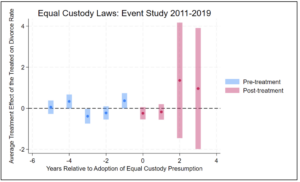
Figure 1. Event study visualization of staggered difference-in-differences regression. Y-axis denotes the average difference in divorce rates per 1000 people between treated and untreated counties that is attributable to an equal custody presumption law. Divorce rate data comes from a 2011-2019 county-level panel assembled by the National Center for Family & Marriage Research (NCFMR) at Bowling Green State University, which I merge with population and median household income statistics from the American Community Survey. States bordering Kentucky and Nevada that are treated through the entire panel are dropped from the regression.
Figure 2 shows that the number of spousal assaults per year declined from approximately 2016 to 2024 in both Kentucky and neighboring states. This indicates that Kentucky’s custody law change likely had no effect on spousal assaults, and indeed, my analysis reveals that the law change had no statistically significant impact on spousal assault relative to bordering states.
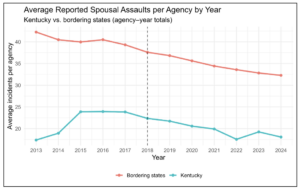
Figure 2. Average reported spousal assaults per law enforcement agency per year. The coefficient for the one-way difference-in-differences (treated × post) variable was statistically insignificant (p = 0.351). Data drawn from a law enforcement agency-level panel on crime incidents produced by the National Incident-Based Reporting System (NIBRS). Agency reporting varies widely by state and year; I focus on comparing Kentucky and bordering states between 2014-2024 due to relatively wide agency coverage (n = 2516).
Conclusion
Why did the law change have no clear effect on divorce and spousal assault rates? One potential explanation is that countervailing forces are at play. For the past 20 years, wives have initiated about 70% of divorces, with one reason being that they are more likely to gain custody of children in divorce court. It is possible that equal custody presumption laws are not only causing fewer wives to initiate divorces, but are simultaneously incentivizing more fathers to initiate divorce since they are more likely to receive custody. These effects would “cancel” within the gross divorce rate and make it appear as though the law had no effect on total divorces.
Another explanation is that, in most states, judges favor joint custody arrangements even in the absence of an explicit legal presumption, suggesting that Kentucky law simply codified existing practice. A 2018 law article published in the Boston University Public Interest Law Journal highlights some examples: in Iowa, courts must consider joint custody if either parent requests it, and in Indiana, a court may grant joint custody even if unrequested. In both cases, judges commonly award joint custody despite the lack of an explicit preference or presumption. If shared custody awards are similarly likely in states both with and without joint custody presumptions, then we shouldn’t expect to see any difference in divorce rates or spousal assault.
While both optimistic and pessimistic predictions about equal custody presumptions abound, this research demonstrates to policymakers that the effects are more modest. Promoting joint custody arrangements likely won’t increase spousal abuse, but a different solution will be needed to raise the longevity of marriages.
 |
Article by Caleb Rasor ’28 |
 |
