
By Sol Kim

American politics has grown increasingly divided over the past decade, shaped by cycles of uncertainty, polarization, and recurring moments when voters perceive the stakes as unusually high. Political donations offer a clear and observable measure of how individuals choose to contribute and engage under these conditions, capturing shifts in participation as political environments change.
Using more than 200 million individual contribution records from the Federal Election Commission (FEC), I aggregated the itemized donations to Democratic and Republican presidential committees across the 2012, 2016, 2020, and 2024 election cycles. The data revealed patterns of polarization and mobilization, shifting from a few wealthy donors toward greater mass participation in Democratic Party fundraising.
The earliest cycle in the dataset reflects an older model of political giving. As shown in Figure 1, participation was limited, while average contribution sizes were substantially larger, with mean donations to both parties exceeding $1,000. This pattern aligned with the political environment of the time. Barack Obama’s reelection campaign relied heavily on established donor networks, while Republican fundraising drew disproportionately on wealthy donors determined to prevent a second Democratic term. In the years that followed, changes in digital fundraising, the rise of small-donor platforms like ActBlue and WinRed, and growing distrust in political institutions created space for many individuals to participate. These developments set the conditions for the dramatic shifts that appear in later election cycles.
Figure 1. Total Contributions and Average Donation Size in Democratic Presidential Campaigns, 2012-2024
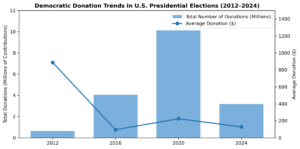
The sharpest break with earlier patterns appears between 2012 and 2016. Across both parties, average contribution sizes fell dramatically: Democratic donations declined from more than $700 per contribution to under $100, while Republican averages fell from above $1,100 to roughly $260. This shift coincided with two broader developments: growing public distrust in political institutions and the rise of insurgent candidacies during the primary elections that positioned themselves in opposition to party leadership. Bernie Sanders and Donald Trump both tapped into voter frustration during their respective primary campaigns, mobilizing supporters who felt disconnected from traditional political channels. Rather than disengaging, many of these individuals began giving in smaller amounts, using donations primarily as a form of expressive participation rather than as a means of purchasing access, influencing electoral outcomes. These trends set the stage for the most dramatic cycle in the dataset. In 2020, Democratic participation surged to unprecedented levels, reaching above ten million itemized contributions. Yet the average donation remained relatively small. This combination of high volume and smaller donations emerged in a political environment shaped by multiple overlapping crises: a polarizing presidency, the Covid-19 pandemic, and widespread social unrest. The picture that emerges is a party mobilized by the convergence of crisis conditions. Republican fundraising in the same period showed a different pattern. Their contribution totals did not nearly expand at the same scale, and average contributions remained relatively low, which indicates a more stable but narrower base of donor engagement.
In 2024, donation patterns shifted again. Participation declined for both parties, though for different reasons. Democratic contributions fell from their 2020 peak of nearly 10 million to roughly three million individual donors. This downturn likely reflects a combination of voter fatigue, economic strain, and uncertainty surrounding the transition from Joe Biden to Kamala Harris. While polarization remained high and the race against Donald Trump was competitive, the absence of the conditions that defined 2020 dampened the kind of coordinated mass participation seen in the previous election.
Existing research helps contextualize why 2020 differed so sharply from surrounding elections. Analysis of the 2020 fundraising environment shows that Donald Trump’s unusually early and aggressive campaign fundraising, which reached nearly $100 million by the end of 2018, may have acted as an early mobilizing signal for Democratic donors, intensifying perceptions of political threat well before the general election (The Fourteen-Billion-Dollar Election). From a behavioral science perspective, large and uncontrollable political shocks are associated with divergent patterns of political engagement: anger is more likely to motivate active participation, while depressive affect tends to inhibit it. Survey evidence indicates that depressive-affect scores rose across partisan groups between 2012 and 2014, a period that coincides with the sharp decline in average contribution sizes observed ahead of the 2016 election. This helps situate the donation patterns within a broader emotional and institutional context, without implying that individual contributions reflect conscious strategic calculation.
This helps explain the Democratic fundraising surge in 2020. That cycle combined overlapping crises, including the pandemic and widespread social unrest, with an unusually high level of partisan threat, producing extraordinary engagement even as average donation sizes remained low. By contrast, the conditions that drove that surge had largely dissipated by 2024. The pandemic had ended, the sense of emergency had faded, and participation declined amid voter fatigue, economic strain, and uncertainty surrounding the transition from Joe Biden to Kamala Harris, despite continued polarization.
Figure 2. Total Contributions and Average Donation Size in Republican Presidential Campaigns, 2012-2024
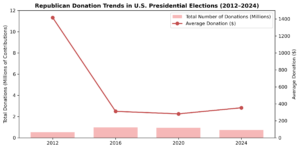
Republican donations followed a different trajectory. Participation remained comparatively limited, but average contribution sizes declined sharply after 2012 and remained closer to Democratic averages than earlier research on Republican fundraising would predict. While Republican donors gave substantially more than Democratic donors in 2012, that gap narrowed in subsequent cycles, falling to roughly $300 per contribution in 2020 compared to about $200 on the Democratic side. This pattern reflects the disruption of traditional Republican fundraising networks during the Trump era. Trump’s populist style weakened the party’s reliance on high-capacity donors without generating a comparable expansion of small-donor participation, leaving Republican fundraising narrower in scale but less dominated by large donors than in the pre-Trump period.
Across the decade, several dynamics emerge. Small donors became central to Democratic fundraising, with participation surging sharply during periods of crisis and heightened collective anxiety, most notably in 2020. Republican fundraising, by contrast, remained narrower in participation but was reshaped by the disruption of its traditional donor base during the Trump era. For both parties, donation patterns appear shaped less by income or demographic characteristics alone than by candidate appeal, organizational capacity, and the broader political environment.
At the same time, important questions remain unresolved. Was the Republican erosion of large-donor dominance a temporary consequence of Trump’s populist leadership and disinterest in conventional fundraising, or does it reflect a deeper vulnerability of elite-driven fundraising under populism? And if so, will Republican fundraising revert if a Trump-aligned successor who prioritizes fundraising seeks to reactivate the party’s traditional donor networks? It remains uncertain whether the rise of small-donor participation reflects a healthier and more inclusive form of political engagement or a new expression of volatility within an increasingly polarized system. What the past decade makes clear, however, is that shifts in the political environment now shape who contributes and how often they give. As voters navigate polarization, declining institutional confidence, and changing party coalitions, donation patterns provide a behavioral record of when participation intensifies, when it recedes, and how citizens engage with electoral politics in moments of heightened political salience.
 |
Article by Sol Kim ’27 |
 |
