
By Ochiro Tugsbilguun

Across much of the world, fertility rates have been falling for decades. Economists often attribute this trend to rising education, urbanization, and the increasing opportunity costs of raising children. Yet one question receives less attention: do expectations about the future economy influence fertility decisions? This article explores whether economic optimism, measured through forward-looking growth expectations, is associated with changes in fertility rates across countries.
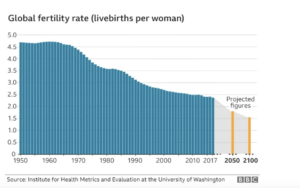
Figure 1: Historical and Projected Global Fertility Rates
Data & Approach
To measure economic optimism, I use IMF GDP growth projections, economists’ expectations about how fast a country’s economy will grow in the near future. I pair this with World Bank data the total fertility rate. Overall, the dataset spans from 2010 to 2023 and includes more than 1,700 country-year observations across 178 countries.
Is There a Visible Relationship?
When economic growth is projected to be stronger, fertility growth tends to be slightly higher as well. Figure 2 illustrates this pattern using binned averages, which smooth out country-year variation. The positive slope suggests that expectations about future economic performance may influence fertility decisions. Because the analysis uses projected growth rates rather than GDP levels, the relationship reflects economic outlook rather than a mechanical link between population size and output.
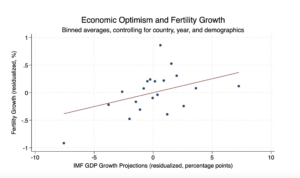
Figure 2. Economic Optimism and Fertility Growth (Binned Averages)
Controlling for Country and Demographic Differences
Countries differ widely in their demographic structures, income levels, and social norms. To isolate the relationship between optimism and fertility, I control for country fixed effects, year fixed effects, female secondary school enrollment, child mortality, and GDP per capita. After removing these confounding factors, I examine the partial relationship between projected GDP growth and fertility growth using a residualized scatter plot.
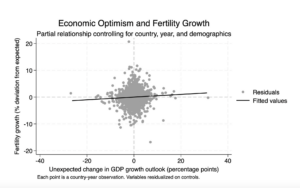
Figure 3. Partial Relationship Between IMF Growth Projections and Fertility Growth
Each point represents a country-year observation after accounting for country-specific characteristics, global shocks, and demographic conditions. The upward slope indicates a positive relationship but the effect remains modest.
What Do the Results Show?
Regression estimates confirm what the figures suggest. A one-percentage-point increase in projected GDP growth is associated with roughly a 0.05 percentage-point increase in fertility growth. While this relationship is statistically significant, its magnitude is small. By comparison, demographic factors such as child mortality have a substantially stronger association with fertility changes. Overall, economic optimism appears to influence fertility decisions, but only at the margins.
Why the Effect Is Limited
Fertility choices reflect long-term considerations that extend beyond short-run economic expectations. Decisions about having children are shaped by education, labor market opportunities, gender norms, and institutional support for families. Temporary optimism about growth may not be sufficient to offset these deeper structural forces.
While the effect is small, it helps highlight an important insight that fertility is not only shaped by demographic fundamentals but can also be influenced by the broader economic optimism of a society.
 |
Article by Ochiro Tugsbilguun PO’26 Data Journalist |
 |
