
By Armine Kardashyan
Over the past decade, the United States has experienced an energy renaissance. Rapid growth in electricity demand, resurgent industrial policy, and ongoing labor market shifts have raised the economic and geographic stakes of energy policy, making climate considerations increasingly central to decisions about infrastructure, manufacturing, and employment. Yet as these stakes have grown, so has political polarization over climate itself. Presidential elections now feature starkly different visions: Biden centered his agenda on aggressive decarbonization and renewed international commitments, while Trump prioritized expanding domestic oil and gas production and loosening regulatory constraints. These competing agendas reflect fundamentally different assessments of climate risk and the costs of mitigation. This article asks how those differences are rooted in local communities: how did climate beliefs change across U.S. counties between 2018 and 2023, and how is that change related to local support for Donald Trump in the 2020 election?
A useful baseline for interpreting such patterns comes from the logic of Bayesian updating. In the standard framework, rational agents revise beliefs in response to new evidence, and agents exposed to common signals (such as increasingly visible extreme weather or widely disseminated scientific consensus) should update in the same direction, even if the magnitude differs. The presence of counties becoming less concerned about climate change over a period in which climate risks became more salient is therefore difficult to reconcile with standard learning models. The observed pattern of counties moving in opposite directions is likewise hard to explain under shared information alone. One explanation is that communities are exposed to systematically different information environments through media, local economic conditions, or elite cues. A second is that individuals assign different weights to common sources, reflecting differences in trust or prior beliefs. A third, more behaviorally grounded mechanism is identity-driven updating, in which new information is interpreted through the lens of partisan or social identity. In this case, identical signals may produce divergent, or even opposing, belief revisions, as individuals align their beliefs with group norms rather than converging toward a common assessment of climate risk. Using Yale Program on Climate Change Communication county estimates of the share of residents who believe global warming is affecting weather (2018 and 2023), MIT Election Data and Science Lab county-level presidential vote returns (2020), and American Community Survey county population data (2018-2023), I construct a county-level dataset and examine how belief change varies across counties and correlates with local Trump support, both geographically and when weighted by population.
Figure 1: Map of the Lower 48 with county population size, illustrating change in belief about climate change’s effect on weather
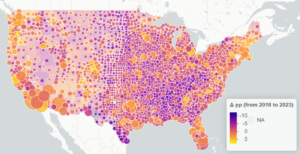
Mapping belief changes reveals clear spatial clustering. Increases in concern are concentrated in major metropolitan regions along the West Coast, the Northeast corridor, and selected Midwestern urban centers; declines are most pronounced across rural areas of the South, Plains, and interior West. The average county experienced a 1.69 percentage point decline in climate concern between 2018 and 2023, while the population-weighted average shows a slight increase of 0.78 percentage points. This implies that the median American became marginally more concerned even as the median county became less concerned. These patterns align closely with the geographic distribution of partisan voting, suggesting that belief change aligns closely with political boundaries rather than being explained solely by economic or environmental conditions.
Figure 2: Belief change per county population size versus voting for Donald Trump in the 2020 election
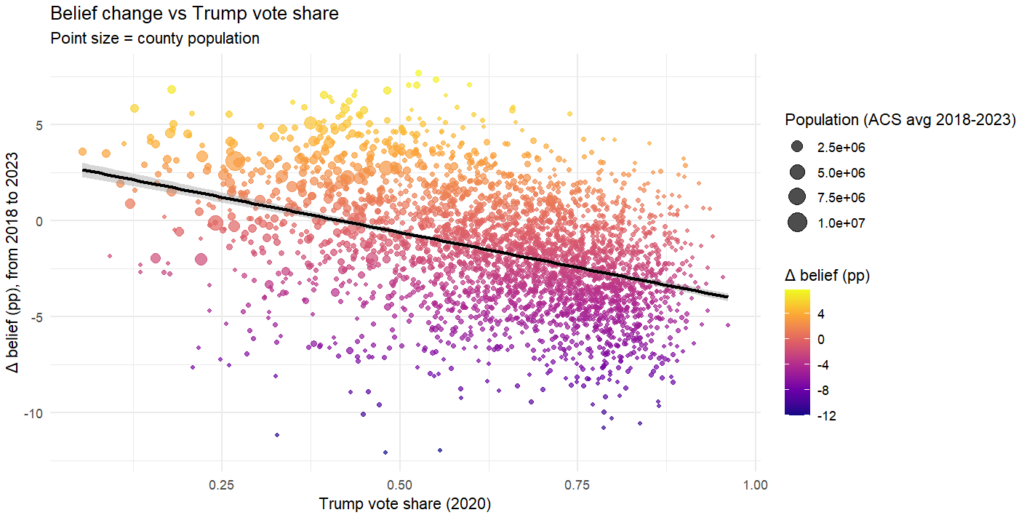
The scatter plot reveals a clear negative relationship between Trump vote share and belief change where counties that gave higher vote shares to Donald T rump in 2020 experienced larger declines in climate concern between 2018 and 2023, while counties that supported the Democratic candidate tended to show stable or increasing concern. The best-fit line passes near the origin, suggesting that “purple” counties with high competition between Democrats and Republicans experienced little net change while strongly partisan counties moved in opposite directions. This directional divergence is difficult to reconcile with standard Bayesian updating under shared information. Rather than converging toward a common national assessment of climate risk, communities appear to be drifting apart along partisan lines. This pattern points toward mechanisms such as identity-driven updating, in which belief formation is shaped not only by information but by alignment with partisan communities. Such geographic polarization carries important institutional implications. Since representation in Congress and the Electoral College is organized by territory rather than population alone, regions with declining concern can exert disproportionate influence over national policy. Understanding where and why these belief gaps are widening will be crucial as the country confronts increasingly visible climate risks in the years ahead.
 |
Article by Armine Kardashyan Data Journalist |
 |
