
Data centers are the new villain in America’s electricity affordability crisis, and the case against them looks compelling on the surface. Goldman Sachs projects that data centers will account for 40% of U.S. electricity demand growth through the end of the decade, pushing household bills up an additional 6% by 2027. A Bloomberg analysis of wholesale pricing across 25,000 grid nodes found that electricity costs near data center clusters have risen as much as 267% since 2020. As tech giants race to build server farms across the country, the dominant narrative is clear: the AI boom is making electricity more expensive for everyone else.
But when you look at retail electricity prices at the state level, that story does not hold up. I analyze monthly industrial electricity prices across all 50 states from January 2020 through November 2025, merged with facility-level data center records from the FracTracker Alliance database. Using a two-way fixed effects regression, I find no statistically significant relationship between data center entry and retail electricity prices. The null result challenges a narrative that may be moving faster than the evidence.
To understand why, it helps to start with what the wrong test looks like. The intuitive approach is to compare electricity prices in states with many data centers to prices in states with few. But data centers do not choose locations randomly. They actively seek out states with cheap, reliable electricity. Washington, Virginia, and Georgia attracted large concentrations of data center activity in part because their industrial electricity rates were already low relative to the national average. This creates a chicken-and-egg problem: states with cheaper electricity attract data centers, so comparing the two groups tells you more about where companies like to build than about what data centers actually do to prices.
A second problem is that electricity prices have been rising everywhere since 2020, driven by natural gas price volatility, post-pandemic demand recovery, and the accelerating cost of grid infrastructure investment. Any state-to-state comparison in this period risks confusing a national trend for a local treatment effect. If Virginia’s prices rose after a data center arrived, we cannot know whether that would have happened anyway, because prices were rising in Virginia’s neighbors too.
The standard solution to both problems is a two-way fixed effects regression. The state fixed effects address the selection problem by comparing each state only to itself over time, removing all the persistent differences between states that make cross-sectional comparisons misleading. The time fixed effects absorb whatever is happening nationally in a given month, whether a gas price spike or a demand surge, that affects all states simultaneously. What remains is a clean estimate of whether receiving more data centers within a state predicts faster price growth in that same state, relative to its own history and to what other states experienced at the same time.
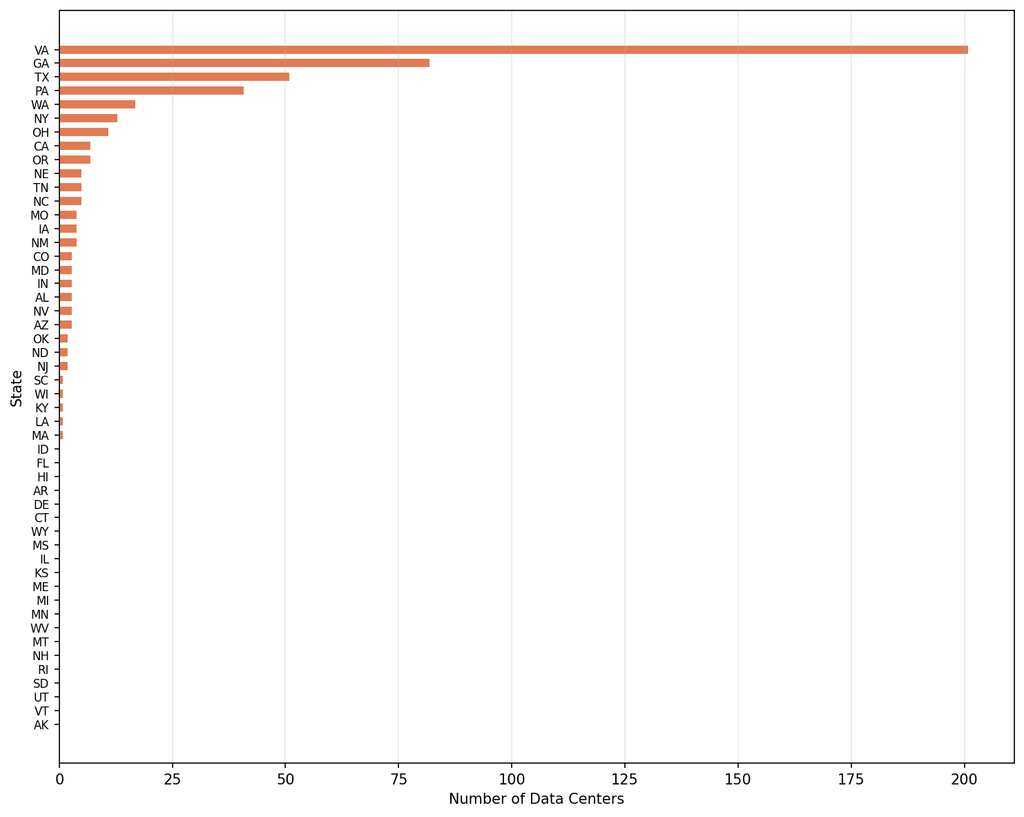
To run this test, I draw on two sources. The FracTracker Alliance database tracks operating data centers across the U.S. by location, operator, and capacity. I restrict the sample to facilities listed as operating and aggregate to a state-month panel, using the cumulative count of data centers as the primary treatment variable. Capacity in megawatts was available for only about 30% of facilities, so facility count is the more reliable measure and is used throughout. Figure 1 shows the resulting distribution of data center activity by state as of November 2025. Virginia leads by a substantial margin, consistent with its status as the world’s largest concentration of data center infrastructure. Twenty-one states recorded no data center entries over the study period and served as the control group.
Figure 1: Cumulative Number of Data Centers by State (as of November 2025)
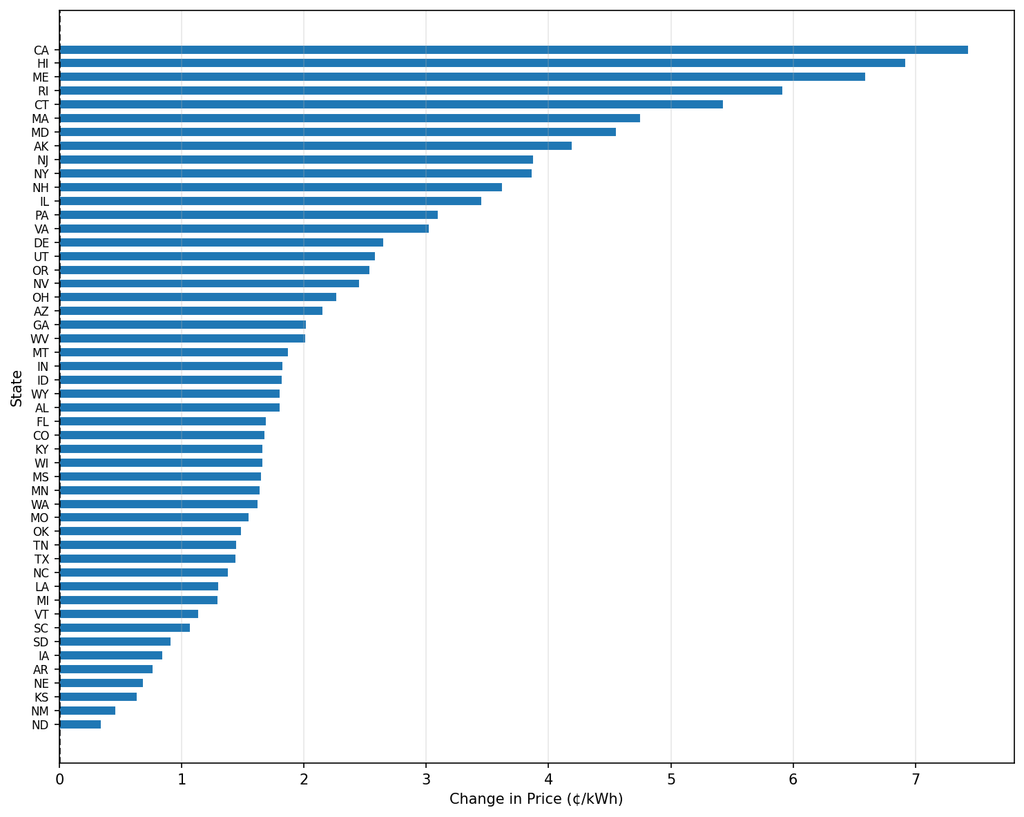
Before turning to the regression, Figure 2 establishes an important context. Industrial electricity prices rose in every single state between 2020 and 2025. California saw the largest increase at +7.4 cents per kWh, followed by Hawaii (+6.9 cents), Maine (+6.6 cents), and Rhode Island (+5.9 cents). This group of top movers includes states with virtually no data center presence. Hawaii, Maine, and Rhode Island recorded no data center entries over the study period. Virginia, which hosts more data centers than anywhere else in the world, saw a comparatively modest increase.
Figure 2: Change in Industrial Electricity Price by State (Avg. 2025-Avg. 2020)
The regression formalizes what Figure 2 suggests. After controlling for each state’s baseline price level and for national monthly trends, adding data centers has no statistically significant association with increases in retail electricity prices. A long-difference specification, comparing each state’s price level in 2020 directly to 2025, confirms the null result in levels. However, the same specification finds a small but statistically significant relationship when measuring prices in percentage terms (p = 0.035). This suggests that states with more data centers may have seen proportionally faster price growth, even if the absolute dollar increase is indistinguishable from states without them. This is also consistent with cross-sectional evidence from the Institute for Energy Research, which found a near-zero correlation between data center counts and state electricity prices in 2025 across all 50 states.
These results do not mean the concern is unfounded. A 2025 working paper by Mamkhezri, Sun, and Yang found meaningful effects of data center connections on wholesale locational marginal prices in Virginia using a propensity score difference-in-differences approach. The distinction matters: in most states, retail rates are set by public utility commissions through regulatory proceedings that operate on multi-year cycles. Even when data center demand pushes up wholesale prices on the grid, that pressure takes time to reach the bills households and businesses actually pay. This regulatory lag is the most plausible explanation for why the effect does not yet appear in state-level retail data, and it also means the null result should not be read as permanent reassurance. Rising electricity prices are real and they are affecting households across the country. But the evidence from state-level retail prices does not support the claim that data centers are the primary cause, at least not yet. The states with the fastest price growth over this period are states with little to no data center activity. After controlling for state baselines and national trends, the arrival of data centers has no significant effect on what consumers pay. As Carnegie Mellon researchers project, data center demand growth could push retail bills up meaningfully by 2030, particularly in high-concentration markets like Northern Virginia. The question is not whether data centers will eventually affect what people pay, but whether that moment has arrived. In the retail price data, across 50 states and five years, it has not.
Article by:
Sol Kim ’27 – Data Journalist
